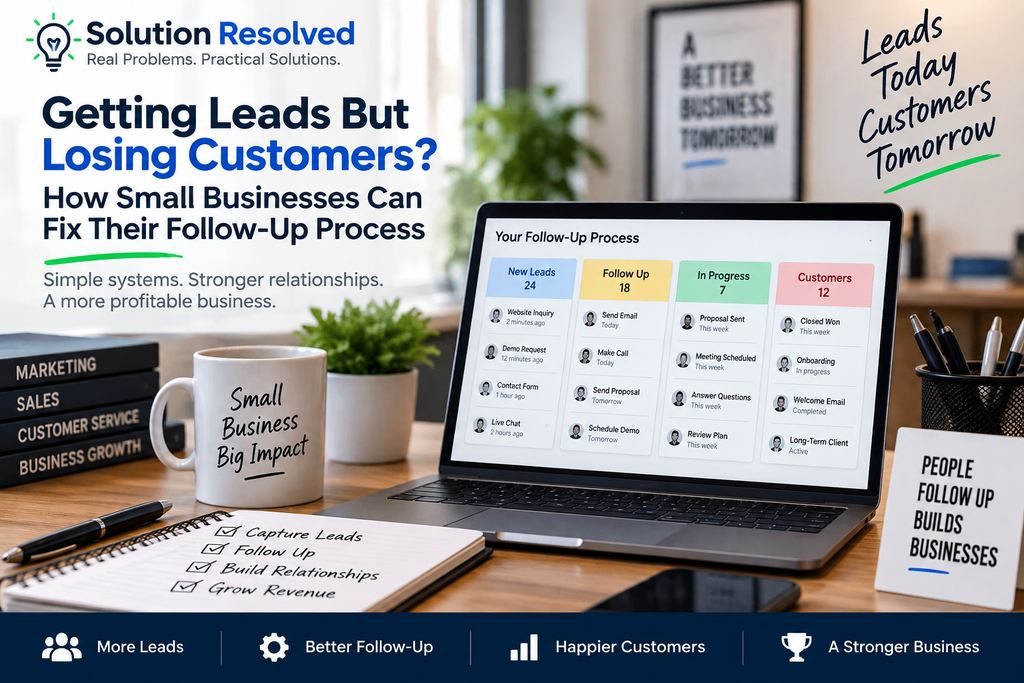
A new lead comes in. They fill out a form, call your business, request a quote, or send a message. You plan to follow up—but the day gets busy. By the time you respond, the potential customer may have contacted someone else. For many small businesses, the problem isn’t getting leads. It’s making sure good leads don’t get forgotten.
Why Leads Fall Through the Cracks
Most small businesses don’t ignore potential customers on purpose. Follow-up usually breaks down because information is scattered across phone calls, text messages, email inboxes, contact forms, notes, and spreadsheets. Without a consistent system to track each lead and the next action, opportunities can easily be missed.
Signs Your Follow-Up Process Is Costing You Customers
- Leads sometimes wait hours or days before receiving a response.
- Customer information is spread across email, text messages, notebooks, spreadsheets, or different apps.
- You can’t quickly see which leads need a follow-up today.
- Follow-up depends on someone remembering to call or send a message.
- Potential customers disappear, and you’re not always sure why.
The Real Fix: Build a Follow-Up System
The solution isn’t simply to “remember to follow up.” A reliable process gives every lead a place to go and makes the next action clear. At a minimum, your system should help you capture new leads, keep their contact information organized, track conversations, schedule follow-ups, and see which opportunities still need attention.
What a Good Follow-Up System Should Include
- Lead capture: A central place to record new inquiries and potential customers.
- Contact history: A record of calls, emails, messages, notes, and previous conversations.
- Follow-up reminders: Clear reminders showing who to contact and when.
- Pipeline visibility: A simple way to see where each potential customer stands in the sales process.
- Automation: The ability to automate appropriate reminders, emails, or repetitive follow-up tasks without losing the personal touch.
Do You Need a CRM?
If you’re handling only a handful of inquiries, a spreadsheet or simple task list may be enough. But as lead volume grows—or when several people need to communicate with potential customers—it becomes harder to keep everything organized manually. That’s where a customer relationship management system, commonly called a CRM, can help. A CRM gives you one place to organize leads, track conversations, schedule follow-ups, and see which opportunities need attention.
Choosing the Right CRM for a Small Business
The best CRM isn’t necessarily the one with the most features. For a small business, the better choice is usually the system your team will actually use consistently. Look for something easy to set up, that keeps lead information organized, makes follow-up obvious, and can grow with the business without forcing you to pay for features you don’t need.
Affiliate disclosure: Solution Resolved may earn a commission if you purchase or sign up through certain links on this page, at no additional cost to you. Our recommendations are based on our evaluation of the solution and how well it fits the problem discussed.
One CRM Option Worth Considering: Pipedrive
Pipedrive is one CRM option worth considering for small businesses that want a more structured way to manage leads and sales follow-up. It provides a visual sales pipeline where businesses can organize leads, track activities, schedule follow-ups, and see which opportunities need attention. For businesses that have outgrown spreadsheets or struggle to track potential customers, Pipedrive can provide a clearer process for moving leads from initial inquiry through the sales process.
When Pipedrive May Not Be the Right Fit
Pipedrive may be more than you need if your business receives very few leads and a simple spreadsheet already keeps everything organized. Businesses that primarily need advanced marketing automation or other specialized tools should also compare Pipedrive with other CRM options. And because every team works differently, consider the features, pricing, and workflow your business actually needs before deciding which CRM is the right fit.
A Simple Follow-Up Process You Can Start Today
- Capture every lead in one place. Stop relying on scattered emails, texts, notes, and memory.
- Record what happened. Keep a short note about the inquiry, conversation, quote, or next step.
- Assign a next action and date. Every active lead should have a clear follow-up action and a deadline.
- Review open leads every day. A quick daily review helps prevent good opportunities from being forgotten.
- Automate repetitive follow-up where appropriate. Use reminders or automated messages for routine tasks while keeping important customer conversations personal.
- Track what happens. Pay attention to which leads become customers and where potential customers tend to drop out of the process.
The Bottom Line
Losing leads isn’t always a marketing problem. Sometimes the opportunity is already there, but the follow-up process isn’t reliable enough to turn that interest into customers. Start by creating a simple system that captures every lead, clarifies the next action, and helps you follow through consistently. If a spreadsheet can handle that for your business, use it. If it can’t, consider a CRM such as Pipedrive.
Ready to Improve Your Follow-Up Process?
If your current system relies on spreadsheets, scattered messages, or memory, start by putting every lead and follow-up task in one place. A CRM can make that process easier to manage as your business grows. Pipedrive is one option worth considering if you want a more structured way to organize leads, track sales activity, and keep follow-up tasks visible. Compare its features and pricing with your business needs before deciding whether it’s the right fit.